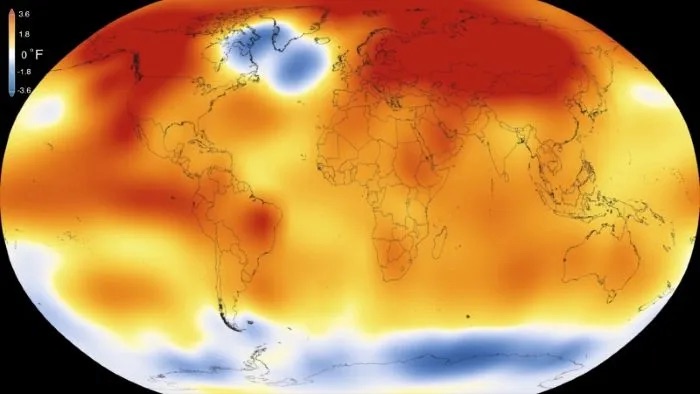

The current that powers the Atlantic Ocean is called the Atlantic Meridional Overturning Circulation (AMOC). This current brings warm water north to the Arctic – and south to the Antarctic – which helps regulates the climates of Africa, Europe, and North America which makes it one of, if not the most, crucial currents on the planet; and easily the most critical current in the Atlantic. There is a growing cold “blob” of water off the coast of Greenland that indicates that AMOC has weakened further which will have catastrophic effects globally.
Scientists have watched with concern as the cold water blob has grown over the last couple of decades because it shows that AMOC is longer able to distribute heat as efficiently as it once was able to. The growth of this blob is in contrast to the dramatic increase in the surface water temperatures that we’ve seen elsewhere in the Atlantic, and around the world.
Amidst the historical AMOC slowdown, a long-term cooling trend of surface temperature has been observed to the south of Greenland10,11 (Fig. 1a), which is known as the North Atlantic Warming Hole (NAWH)12, and in contrast to global warming elsewhere13. The formation of the NAWH was attributed primarily to the AMOC slowdown and associated meridional oceanic heat transport divergence across the North Atlantic.” – Kai-Yuan Li & Wei Liu, Communication earth & enviornment
Receive future updates from the Evergreen PI
Not only does this indicate that AMOC is struggling to bring warm water up north to the Arctic, it also means that cold water is no longer being brought south to the equator and beyond. There is growing evidence that the slowing of this critical ocean current has shifted weather patterns and driven the increase in violent hurricanes in the Caribbean, torrential rain falls along the African west coast, and the deadly heat waves that have roiled Europe over the last decade.
The increased rainfall will also screw over crop production in the American northeast, and the African west coast, as their fields will be inaccessible for longer which would make it more difficult to get crops planted and harvested in time before the winter hits. There is also a chance that Europe may unlock more arable land as the globe continues to warm, if AMOC continues to slow the wouldn’t be able to access the fields due to the increased droughts on the continent and those gains would be wiped out.
Scientist have used data from satellites and ocean monitoring sensors to check in on AMOC. But their ability to monitor the current, and ocean temps, has been threatened as the Trump administration currently has plans to remove 900 deep-sea monitoring instruments that have played a key part in these studies.
More from the Evergreen Post Intelligencer
- Sloppy defense doomed Cougars soccer to its first loss against Idaho since ’99

- Unincorporated Snohomish County to have $20 car tab in order to fund Public Works road repairs
- Lynnwood City Council approved the long-term water plan, critical area ordinance
- Snohomish County Council passed the 0.1% public safety sales tax

- LPD chief briefed the council on how the department will use the public safety grant, sales tax

- Union treasurer Burgess appointed to fill vacancy on Lynnwood PFD board

Discover more from Evergreen Post Intelligencer
Subscribe to get the latest posts sent to your email.
