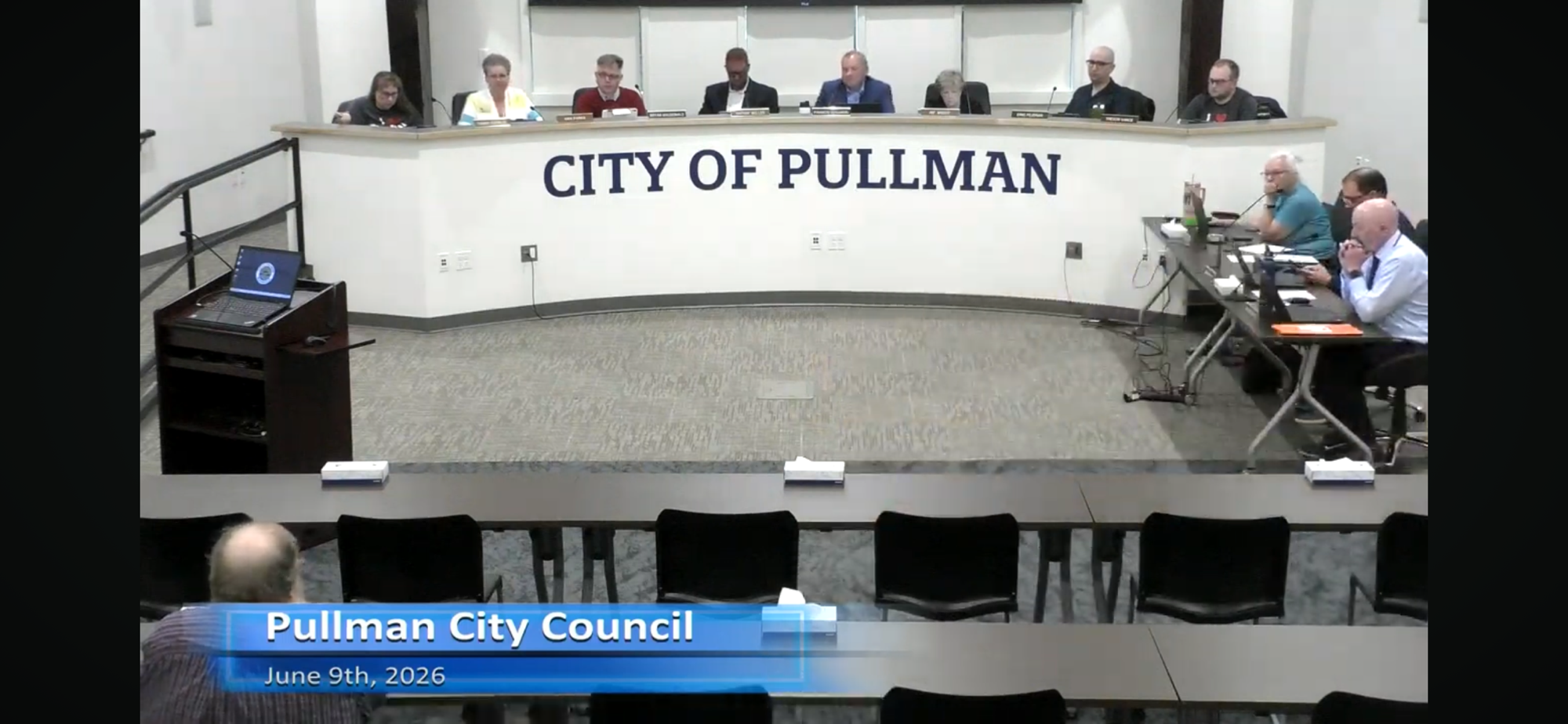

Last June, Pullman’s City Council tightened safety regulations on short-term rentals – Air B&Bs, for example – and that led to an outcry from the owners that the new regulations were burdensome. In response to the public feedback, the Planning Commission recommended an easing of the regulations with an exemption that brought these regulations more in line with state requirements. While the staff from the city’s Planning Department voiced strident objections to easing these regulations, the council voiced nearly unanimous support for amending the code.
City Council members were almost unanimous in their support for an amendment to the regulations that would provide an ease the regulations to ease cost for some owners of short-term rentals (STRs). The commission’s recommendation was an exemption if the below conditions were met:
- A long-term resident resides at the property
- Two (2) or fewer bedrooms are rented short-term at anytime; and
- The total occupancy of the dwelling unit does not exceed 10 persons
This proposed exemption eases the requirements for a business licence, fire extinguishers, smoke detectors, carbon monoxide detectors, insurance requirements, emergency lighting, and evacuation maps that were added with the new regulations last year for the STRs that qualify. Community Development director RJ Lott advised the council that it would be practically impossible for city staff to independently verify that short-term rentals actually meet all three requirements to qualify for the exemption.
Lott was also asked how the existing code matched the online STR platform’s minimum requirements, he advised they are similar. But the primary difference is that the city can conduct onsite inspections to ensure compliance and the online platforms cannot.
While the public, and council, comments were filled with concern about how these new regulations create a high barrier for entry into the city’s short-term rentals market, Lott pointed out that easily accessible flashlights, a hand drawn evacuation map, and a wall mounted fire extinguisher would meet the existing safety codes. The more significant cost associated with the new regulations, however, are the business licences (state and municipal) and insurance requirements that will remain unless the exemption passes.
The only council member to express any kind of reservation about the exemption was Eric Fejeran. In his comments, Fejeran was supportive of the Planning Commission’s recommended exemption; he voiced support for requiring the exempted STRs to still be required to provide emergency lighting, a fire extinguisher, smoke & carbon monoxide detectors, and an evacuation map. That’s in contrast with several of his colleagues who expressed a firm belief that the rental owners would do everything in their power to keep their properties safe.
Despite the clearly stated safety concerns from the city staff, the council moved forward with a formal request of staff to have a new ordinance prepared to codify the exemption. The vote was 7-0.
Receive future updates from the Evergreen PI
Washington Wildlife and Recreation Program Grant Application
The city’s staff has prepped a grant application to modernize and enlarge the skate park at Spring Street Park; the funding would come Washington State Wildlife and Recreation Program. This grant application would cover $500,000 of the projected $750,000 construction cost. Before the application can be sent, the council needed to vote on a resolution to authorize the submission.
As part of this renovation, the skate park will increase the skate park size by 7500 square feet with additional green spaces, benches, and area lighting around it to make the park a general use facility while the skate facility would have an appeal to skaters with varying skill sets. The expanded park will also be able to handle all wheeled recreational users – i.e., skateboard, BMX, in-line, scooters, and more. It was pitched as a way to increase the usage of the park while also improving security with expanded lighting to improve security.
Improvements to the park of have been part of the city’s capital improvement plan since 2020.
Pullman’s lone skate park was built in 1999 and is too small for its current uses. The largest maintenance cost for the existing parks is graffiti removal or repairing damage caused by skaters who have attempted to make their own additions to the ramps, rails, or jumps.
Council members asked about alternative funding, like the Tony Hawk Foundation, and were informed that the grant fund is the main source the city staff looked at. When council member Bryan MacDonald asked about what the council’s options were if the general fund couldn’t support the remaining $250,000 needed to finish construction during the projected start in 2029. The response was that they could re-engineer the project to reduce it’s cost, but they need to keep in mind that the state grant requires a 10% match from the city.
The council approved the resolution to submit the grant application 7-0.
Interlocal governmental agreement with WSU
Since 2001, Pullman and Washington State University have operated under an interlocal government agreement to help fund maintenance for shared sewer/waste water pipes along with the waster water treatment facility. While the agreement initially expired in 2021, it has been extended on a year-by-year basis in the aftermath of the pandemic. The council was presented with the new 20 year interlocal agreement and voted to approve it.
The cost share distribution covered by the agreement is determined based off of flow rate and pollutant loading characteristics. WSU’s waste water and sewer system is managed independently of the city’s until they meet at a few interceptor pipes on the path to the waste water treatment plant. In the new agreement, the university will be responsible for 28% of the cost of maintenance and capital projects for the shared facilities; that’s a significant drop from the 36.4% of the cost that Washington State paid for under the 2001 agreement – a loss of roughly $250,000 in funding.
To determine the new level of WSU’s contribution, the city hired JB Engineers to conduct a flow and loading study back in 2019. The original study was interrupted by the pandemic; and wasn’t restarted until the enrollment numbers at the University stabilized which is what necessitated the year-by-year extension of the 2001 agreement.
It was briefly mentioned that staff is examining a potential utility rate increase to cover the lost revenue from Washington State’s reduced cost share. MacDonald asked if there was another funding mechanism available and was advised that while it’s still early into the process, it’s unlikely there is another funding mechanism available.
This resolution was passed in a 7-0 vote.
Other news brought up in the council meeting
There were a couple of other items brought up in the meeting. Pullman Fire Department has only received one application for a firework retailers permit; the seller is new but the supplier is TNT fireworks as it has been in the past. There was also a pair of public hearings on the capital and transportation improvement plans as the state requires an annual update by July 1st; there were no public comments or questions/concerns from the council members.
More from the Evergreen Post Intelligencer
- Storm collapsed late in the fourth, lost ninth straight

- ICE kidnapped a student off of Edmonds College’s campus

- Pullman City Council voted to pass the exemption for short-term rentals
- Lynnwood City Council received an update on amendments to the critical area ordinance

- ANALYSIS: Trump’s new peace deal with Iran is really just another cease fire doomed to fail

- WSU’s Rosemary Longisa won the 1,500 meter National Title

Discover more from Evergreen Post Intelligencer
Subscribe to get the latest posts sent to your email.
