

In 1919, the Michigan Supreme Court handed down a decision in Dodge V. Ford that set the expectation that corporate officers had to prioritize the profit of a company’s shareholders over the well being of its employees and customers. The decision came because the Dodge brothers sued Henry Ford over his decision to slash special dividend payments to his minority shareholders because he wanted to raise pay for his employees, cut the cost of the Model T, and expand production by building a larger factory. It’s a decision that does not legally define shareholder supremacy, but laid the groundwork for the modern legal doctrine that governs American corporations.
The state supreme court voted that the John and Horace Dodge had the right to force the company pay out the special dividend out of the $60 million surplus it had earned. This also meant that the court had basically ordered a halt to further price cuts for the Model T, the planed wage increase to his employees, and slowed down his new planned production complex. It was a decision that specifically required the Ford Company to prioritize its shareholders over his plans to expand his monopoly.
Ford was in the planning stages of a massive new factory complex at River Rouge, the company still uses it today, in 1916 when he notified his minority shareholders that he planned to cease paying the special dividend – an extra payout on top of the standard 5% dividend the shareholders already received. He felt that this decision was justified as the company had made over a $60 million surplus and he wanted to ensure the continued monopoly of Ford Motor in the automobile field. The complex at River Rouge was planned to help exponentially boost production of the Model T so that the company would be able to meet demand on the already cheap car.
This decision to cut the special dividend was driven by the fact that Ford had realized the Dodge brothers were using that payout to start their motor company. In order to prevent that competition, he tried to close the tap and cut off a major source of funding for the Dodge Brothers Company.
At the same time as he realized the growing threat from his minority investors, the company was threatened by the arrival of organizers from the Industrial Workers of the World. The Wobblies had started to recruit his factory employees in an attempt to unionize and force Ford to the negotiating table. It’s this threat that prompted the massive pay raises for the employees, along with the expansion of the work force; because he understood that it’s hard to organize against the boss when the boss just gave you a massive pay raise and opened up a job for your cousin or brother.
The Dodge brothers’ lawsuit rapidly worked its way up to the Michigan Supreme Court where chief justice Russell C. Ostrander wrote:
There should be no confusion (of which there is evidence) of the duties which Mr. Ford
conceives that he and the stockholders owe to the general public and the duties . . . he and
his codirectors owe to . . . minority stockholders. A business corporation is organized and
carried on primarily for the profit of the stockholders. The powers of the directors are to
be employed for that end. The discretion of directors is to be exercised in the choice of means to attain that end and does not extend to a change in the end itself, to the reduction
of profits or to . . . devot[ing] them to other purposes. – Michigan Supreme Court, Dodge V. Ford
While the decision was written in such a way as to give directors the ability to make long-term investments that benefited the long-term health of the company, the lingering precedent has lent to a lengthy history where companies have made decisions that benefited stockholders in the short-term while putting the customers and employees at risk.
Decisions by the Michigan Supreme Court in 1931 and 1934 both upheld the precedent set by Dodge V. Ford and the need of corporate officers to prioritize stockholder returns. While there have been a few, narrow, decisions that upheld the power of these officers to make long-term decisions that will provide a greater profit to these shareholders, the reality is that America’s corporate overlords have made it clear that the safety and satisfaction of the end user is not their main focus when developing products.
Catastrophic consequences
A great example of the catastrophic consequences is the process that led to the creation of the 737 Max. In the mid-2000s, Airbus announced that it was going to reengine its A320 family aircraft with larger, more fuel efficient engines. This created a crisis at Boeing as the company knew that the certification process for the A320neo family of aircraft would be quicker because of the reengine, instead of the lengthy process it takes for an entirely new airframe.
Another benefit to the A320 reengine was that airline pilots would not have to train and earn a new type certification to fly the aircraft. They’d be able to use their certifications from the original A320 family aircraft on the new one with minimal time spent in the simulator – a huge cost savings for Airbus customers.
The 737 is an airframe that was designed in the 1960s for smaller airports than the A320 flies into, thus its wheels are closer to the ground and there is less space under the wing for the larger, efficient turbofan engines that were being attached to the neos. Boeing could have, and probably should have, designed an entirely new short haul airliner that could accommodate these engines…but that would take well over a decade and the company did not want to risk its short-term revenue streams. Which meant that they needed to figure out how to reengine the 737 without modifying its airframe and forcing an new type certification process with the FAA, and for the airline pilots.
Boeing’s engineers came up with the solution of pulling the high-bypass turbofan engines out further forward than the existing engines on the 737 so they could be mounted higher. This allowed the 737 airframe to remain the same, while also fitting the engines on the aircraft.
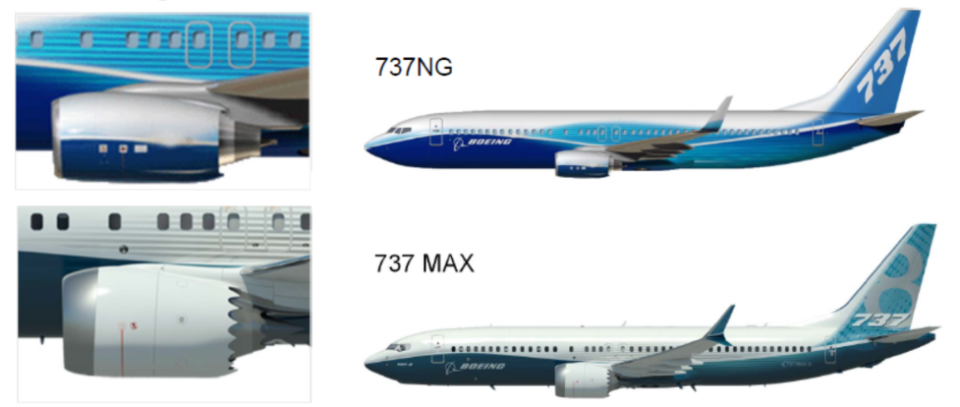
The larger engines being mounted further forward, and higher, on the wings did change the handling characteristics of the aircraft because it how had a tendency to pitch the nose up. Because it was imperative that Boeing not only get the Max certified quickly (and keep the type rating the same) the company came up with a software solution to fix this issue, they called it the Maneuvering Characteristics Augmentation System (MCAS) to help force the nose down when it would pitch up.
MCAS was run off of one sensor on the nose with no redundancies built in, which meant that if the single angle of attack (AoA) sensor used for the software ever became jammed then the software would issue commands to the aircraft based off false data.
Boeing made the decision to not reveal the existence of the changes to the Max’s handling characteristics (or the existence of MCAS software) to the FAA, the airlines, or the pilots. They knew that there was a chance that the FAA might require more training for pilots to obtain a new type certification which would have made the entire 737 Max program pointless.
The FAA certified the aircraft on March 8th, 2017 without any knowledge of the software and its single point of failure.
It was jammed sensor that fouled up the MCAS software on Lion Air flight 610 on October 29, 2018. Unaware of MCAS and its purpose (to keep the nose trimmed down), the pilots were horrified when their aircraft started an uncommanded pitch down towards the sea. The two men struggled for 10 minutes to keep their aircraft in the air, while its computer fought against them and pitched the nose down. 189 lives were lost when the 737 slammed into the Java Sea, it is the deadliest accident in the history of the 737 airframe to date.
In the immediate aftermath of the accident, the Indonesian National Transportation Safety Commission publicly brought to light the existence of MCAS. Boeing issued a Operations Manual Bulletin (OMB) to operators of the 737 Max aircraft that had been delivered on how to train pilots to disable the software in the event of a similar failure.
This advice proved ineffective when Ethiopian Airlines flight 302 crashed a little over 11 minutes after it took off from Addis Ababa on . The pilots had been trained according to the OMB issued by Boeing, and were able to shut down MCAS which stopped the computer commanded pitch down; but the speed of the aircraft kept the trim in the same pitch down position which forced the pilots to yank back on the yoke to keep the aircraft out of a fatal dive. In a desperate attempt to restore the trim tab to a neutral position – which was needed to keep their aircraft in the air – the pilots restarted the electrical trim tab system…and that restarted MCAS which forced the plane into its final dive.
The crash in Ethiopia resulted in 157 deaths.
If Boeing hadn’t been focused on its short-term revenues, the company would have tasked its engineers with a clean sheet (brand new) short haul aircraft that would have allowed the company to finally retire the 737. This new airframe would have not required the compromise to its aerodynamics for the large, efficient turbo fan engines that the 737 did, thus it would not have required the company to develop a software that it hid from federal regulators and its customers. But the company did not want to risk a drop in its revenue because that would drop the values of its shares on the stock market; which would have caused harm to the Boeing’s stockholders.
And thanks to Dodge V. Ford, the stockholders had legal precedent that they needed to be put first.
More from the Evergreen Post Intelligencer
- Sloppy defense doomed Cougars soccer to its first loss against Idaho since ’99

- Unincorporated Snohomish County to have $20 car tab in order to fund Public Works road repairs
- Lynnwood City Council approved the long-term water plan, critical area ordinance

- Snohomish County Council passed the 0.1% public safety sales tax

- LPD chief briefed the council on how the department will use the public safety grant, sales tax

- Union treasurer Burgess appointed to fill vacancy on Lynnwood PFD board
Discover more from Evergreen Post Intelligencer
Subscribe to get the latest posts sent to your email.
