

Washington State has an air travel problem, and there is no quick fix. Seattle-Tacoma International Airport (SEA), the state’s primary commercial gateway, is processing tens of millions more passengers annually than it was designed to handle. The plans to address this, via a new terminal at SEA, expanded capacity at Paine Field (PAE), and other potential statewide solutions, are underway. But with projected traveler volumes outpacing expansion plans, travelers are unlikely to experience relief any time soon.
For many, a traveler’s experience at SEA evokes a feeling of chaos. According to last year’s JD Power survey of mega airports (airports serving 33 million or more passengers), SEA was ranked 17th out of the 20 surveyed in overall customer satisfaction. To those of us who’ve experienced the traffic congestion, unforgiving security lines, awkward screening process, and flight delays at SEA, this meager ranking is no surprise.
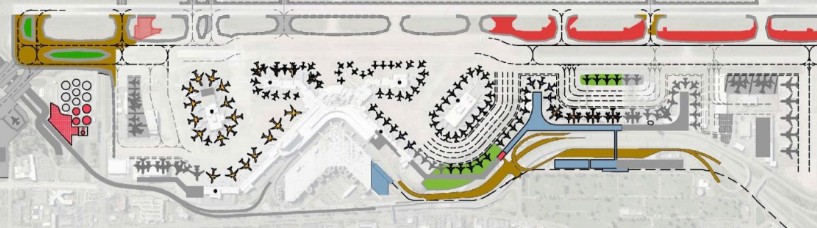
Fortunately, the Port of Seattle recently issued its Sustainable Airport Master Plan (SAMP) which highlights several near-term projects (NTPs) that are planned to be started or completed by 2032. As stated on the Port of Seattle’s SAMP page, these 31 projects are focused on improving passenger processing, operational facilities, cargo capacity, and airport access.
To meet these objectives, some of these projects include the construction of an entirely new passenger terminal and a multi-level concourse which is planned to house 19 new gates. In order to configure the site for the new terminal, there will be a complex exercise of demolition, relocation, consolidation, and new construction.
The SAMP estimates the second terminal and concourse could be completed by 2027 and, according to simulation modeling, should accommodate 30% of the total projected passengers for 2034. Given the need environmental reviews, approvals, permitting, and complex logistics still required, the 2027 timeline for construction and opening of the second terminal seems unlikely to be a sustainable timeline.
The recently unveiled multi-level “PNW flair” expansion to concourse C creates a pleasant experience once travelers reach it. Still, it feels akin to adding custom leather seats to a car with flat tires.
Everett’s Paine Field Airport (PAE) also has an enhancement plan to accommodate passenger growth rates, with the addition of up to four gates along with the necessary parking, taxiway, runway, and airport support facilities. By 2040, the airport is forecasted to handle up to six million passengers. While Snohomish County’s airport will help, it cannot entirely relieve SEA’s overflow because further expansion is unlikely due to the limitations to the airfield’s footprint.
While the combined SEA and PAE expansion plans are planned to accommodate the state’s baseline growth, WSDOT estimates that a surplus of 27 million annual passengers are unaccounted for.
To address this, a now-disbanded work group, the Commercial Aviation Coordinating Commission (CACC), was tasked with solving for the state’s future aviation needs. Their last recommendation settled on new municipal airport locations in Pierce County Central, Pierce County East, or Thurston County near Olympia. Each recommendation was met with fierce public push back.
The state legislature appointed a Commercial Aviation Work Group (CAWG) in 2023 to “provide a comprehensive investigation of airport capacity in the state and the best way to address aviation needs in the context of overall state transportation needs in the next 20 years, using independent, verifiable data.” Unlike the CACC, CAWG is not tasked with finding a location for a new airport, but is mandated to consider expansion possibilities within existing facilities. In the past 12 months, CAWG has discussed solutions involving regional airports, including Spokane, Yakima, and PAE. Future technologies, like electric vertical take-off and landing (eVTOL) and enhanced rail solutions, are also being explored by the group.
As an alternative, Seattle’s Port Commissioner Sam Cho has recently publicly stated his idea of constructing a major airport in Moses Lake (Grant County), connected to both sides of the state via a high-speed train.
“If you go to every major city in the world, whether it’s London, Hong Kong, Seoul, South Korea, they have their airports an hour or two away, three hours even, from the city center, and they have a high-speed bullet train that goes between the main city center and the airport,” Cho said in a recent KIRO NewsRadio program. This solution, he said, could alleviate traveler congestion and provide a more efficient distribution solution to Washington farmers.
SAMP comment period is now open
The Port of Seattle has published a dedicated page listing upcoming public meetings to for public SAMP discussion, as well as a form for submitting comments. The public comment period will end on July 21st at 4:00 pm.
This is the community’s opportunity to raise questions or concerns. For example, will SAMP eventually address the tremendous backups at the beginning of the departure lanes, where Alaska Airlines is located? As Alaska accounts for 42 to 49% of SEA’s travelers annually, locating the drop-off at the beginning of the line is a traffic planning blunder. Also, have the planners noticed the hundreds of cars that abandon using the cell-phone waiting lot and pull over to the side of the road? Will plans for airport roadway access improvements alleviate the difficulty of exiting the cell-phone waiting lot?
Whether or not Cho’s grand vision comes to pass, elevating Washington’s aviation capacity to a state-of-the-art network could finally align air travel infrastructure with the state’s reputation as a global business and innovation hub.
More from the Evergreeen Post Intelligencer
- Sloppy defense doomed Cougars soccer to its first loss against Idaho since ’99

- Unincorporated Snohomish County to have $20 car tab in order to fund Public Works road repairs
- Lynnwood City Council approved the long-term water plan, critical area ordinance

- Snohomish County Council passed the 0.1% public safety sales tax

- LPD chief briefed the council on how the department will use the public safety grant, sales tax

- Union treasurer Burgess appointed to fill vacancy on Lynnwood PFD board

Discover more from Evergreen Post Intelligencer
Subscribe to get the latest posts sent to your email.