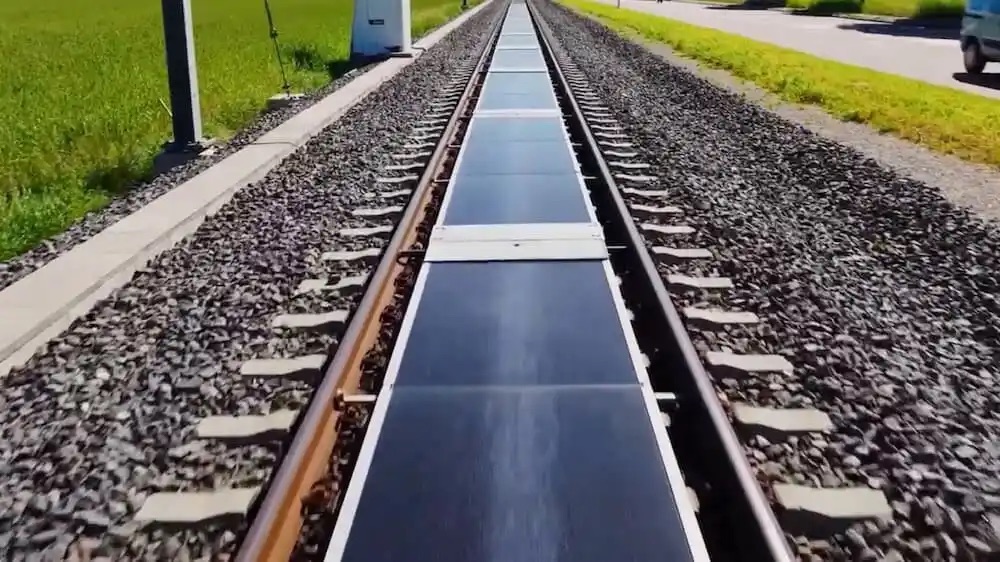

Last year the Swiss start-up Sun-Ways rolled out the world’s first solar railways as a three year pilot program to check on the feasibility of installing solar panels between active tracks. The first year of the program was such a success that it’s likely the program will become permanent and expand, according to EuroNews. There has been interest from companies in other countries in trying out the new solar panel technology on their rail networks
In the small village of Buttes, Sun-Ways installed 100 meters of photovoltaic (PV) solar cells between active tracks. In the year since the 48 panels were installed. Over 11,000 trains have rolled over cells as they’ve generated the 16,000 kWh – equivalent to the energy demand of an average house in the UK – throughout the first year of the trial. As for one of the major concerns regarding the installations, train conductors have not reported that they’ve struggled with sunlight as it reflected off of the panels. These early results have led to the likely hood that the Swiss government will allow the installation to become permanent and for an expansion of it across further parts of the network.
Receive future updates from the Evergreen PI
Already a company in Italy has worked out with a deal to run their own pilot program to test out the effectiveness in of the solar railways. The South Korean government has also signed off on a pilot program as well. These two country’s are just the furthest along in integrating the new technology into their railroads; companies in France, India, China, and Singapore are all negotiating for their own pilot programs.
One of the major problems with building solar panels onto rail roads is the way the track flex as trains roll over that could lead to the development of micro cracks in the panels; the company also invested in filters that limit the reflection off of these cells. Sun-Ways has built thicker, more resilient panels that are able to better withstand the movement of tracks. They’ve also incorporated sensors to allow them to better monitor the performance of the panels and the structural well being as well. As for debris that build up on the panels, trains are fitted with brushes to help them clean them off as they pass over.
The horizontally mounted panels have produced roughly 10% less energy than the panels that are mounted at an angle onto the roof of buildings. This power that has been generated by these 48 PV cells has been sent into the neighboring electric grid.
More from the Evergreen Post Intelligencer
- Sloppy defense doomed Cougars soccer to its first loss against Idaho since ’99

- Unincorporated Snohomish County to have $20 car tab in order to fund Public Works road repairs
- Lynnwood City Council approved the long-term water plan, critical area ordinance
- Snohomish County Council passed the 0.1% public safety sales tax

- LPD chief briefed the council on how the department will use the public safety grant, sales tax

- Union treasurer Burgess appointed to fill vacancy on Lynnwood PFD board

Discover more from Evergreen Post Intelligencer
Subscribe to get the latest posts sent to your email.
